

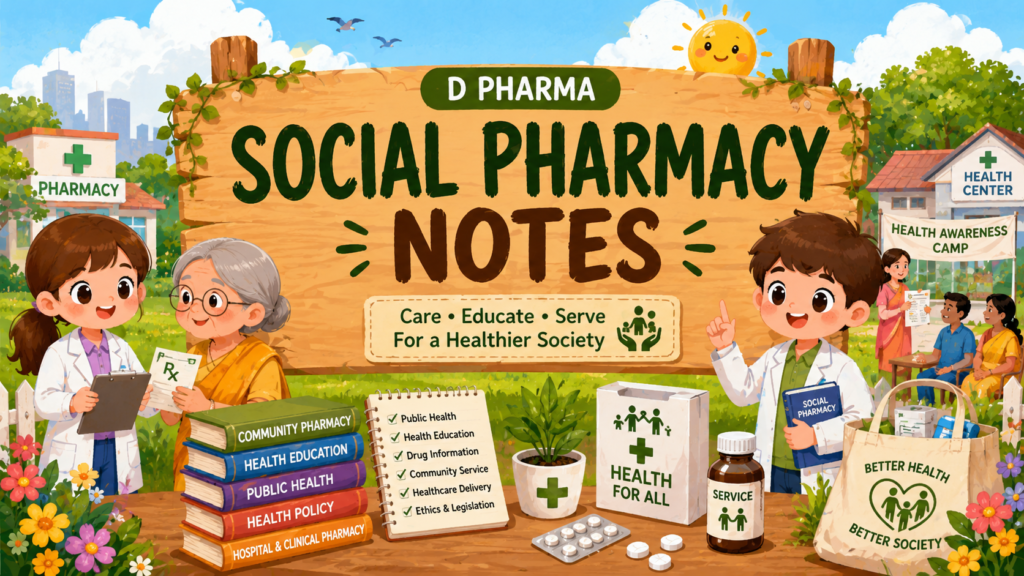
Healthcare is not limited to hospitals and medicines alone—it also depends on public awareness, hygiene, nutrition, disease prevention, and access to proper medical support. These broader aspects of community health are studied in Social Pharmacy, an important subject in D Pharma 1st Year that connects pharmacy education with real social and public health responsibilities.
This subject helps students understand the pharmacist’s role beyond dispensing medicines. It introduces concepts related to national health programs, preventive healthcare, population health, lifestyle diseases, and the safe use of medicines in society. Through this subject, students begin to see how pharmacists contribute directly to improving community well-being.
These Social Pharmacy Notes – Download PDF Now (D Pharma 1st Year) are prepared according to the current diploma syllabus and organized in a simple chapter-wise format for easier learning. Whether you are studying for theory exams, assignments, or revision, the notes are designed to explain public health concepts in a clear, practical, and easy-to-understand manner.
Download Social Pharmacy Notes PDF – Chapter Wise
Click below to download free PDFs for each unit:
Chapter 1: Introduction to Social Pharmacy
Topics Covered: Introduction, definition, and scope of Social Pharmacy; role of Social Pharmacy in improving public health; role of pharmacists in public healthcare services; concept of health including WHO definition, dimensions, determinants, and health indicators; National Health Policy from the Indian perspective; public and private healthcare systems in India and National Health Mission; introduction to Millennium Development Goals (MDGs), Sustainable Development Goals (SDGs), and FIP Development Goals.
Chapter 2: Preventive Healthcare – Role of Pharmacists
Topics Covered: Role of pharmacists in preventive healthcare including demography and family planning; mother and child health; importance of breastfeeding and harmful effects of infant milk substitutes and bottle feeding; overview of vaccines, immunity, and immunization; effects of environmental factors on health including water pollution, air pollution, noise pollution, sewage and waste disposal, occupational illnesses, and pharmaceutical pollution; psychosocial pharmacy including drug misuse and abuse of psychotropics, narcotics, alcohol, and tobacco, along with their social impact and suicidal behaviours.
Chapter 3: Nutrition and Health
Topics Covered: Basics of nutrition including macronutrients and micronutrients; importance of water and dietary fibres; balanced diet, malnutrition, nutrition deficiency diseases, harmful effects of junk foods, calorific and nutritive values of foods, and food fortification; introduction to food safety, food adulteration, artificial ripening, pesticides, and genetically modified foods; dietary supplements, nutraceuticals, food supplements, their indications, benefits, and drug-food interactions.
Chapter 4: Introduction to Microbiology and Epidemiology
Topics Covered: Introduction to microbiology and common microorganisms; basics of epidemiology and related terms such as epidemic, pandemic, endemic, outbreak, quarantine, isolation, incubation period, contact tracing, morbidity, and mortality; causative agents, epidemiology, clinical presentation, prevention, and pharmacist’s role in educating the public about communicable diseases including respiratory infections, intestinal infections, arthropod-borne infections, surface infections, STDs, and HIV/AIDS.
Chapter 5: National Health Programs in India
Topics Covered: Introduction to healthcare systems and ongoing National Health Programs in India; objectives, functioning, outcomes, and role of pharmacists in the successful implementation of national healthcare initiatives.
Chapter 6: Introduction to Pharmacoeconomics
Topics Covered: Introduction to pharmacoeconomics including basic terminologies, principles, scope, and importance of pharmacoeconomics in healthcare decision-making and cost-effective use of medicines.
What is Social Pharmacy?
Social Pharmacy is the area of pharmacy that studies how medicines, healthcare services, and society are connected with each other. It focuses on improving public health awareness, promoting the safe use of medicines, and understanding the pharmacist’s role in community healthcare.
For D Pharma 1st Year students, this subject is important because it introduces the social and healthcare responsibilities of a pharmacist beyond medicine dispensing. It helps students understand health education, disease prevention, rational drug use, and the impact of healthcare programs on society.
These notes will help you understand topics like:
- Introduction to Social Pharmacy and Public Health
Basic concepts of social pharmacy, healthcare systems, and public health services. - Role of Pharmacists in Community Healthcare
Responsibilities of pharmacists in patient counseling, medication guidance, and health awareness. - Nutrition and Preventive Healthcare
Importance of balanced nutrition, hygiene, vaccination, and preventive measures for healthy living. - National Health Programs
Government healthcare initiatives related to communicable and non-communicable diseases. - Family Welfare and Population Health
Concepts of family planning, maternal care, and community health management. - Rational Use of Medicines
Safe medication practices, prevention of self-medication, and awareness about drug misuse. - Lifestyle Disorders and Health Education
Understanding diseases such as diabetes, hypertension, obesity, and promoting healthy habits. - Pharmacist’s Role in Health Promotion
Participation of pharmacists in spreading healthcare awareness and supporting public well-being.
These Social Pharmacy Notes PDF for D Pharma 1st Year are designed to simplify community health concepts, improve exam preparation, and help students develop a practical understanding of pharmacy’s role in society.
Frequently Asked Questions (FAQ)
Q1. What is the primary goal of Social Pharmacy?
Social Pharmacy explores the connection between medicines, healthcare services, and society. It aims to transform pharmacists from simple medicine dispensers into community health educators who promote public awareness, hygiene, and the rational use of drugs.
Q2. What public health concepts are covered in the "Introduction" chapter?
Chapter 1 introduces the WHO definition of health and discusses:
Health Indicators: Metrics used to measure the health of a population.
National Health Policy: The Indian perspective on healthcare delivery.
Global Goals: An overview of Millennium Development Goals (MDGs) and Sustainable Development Goals (SDGs).
Q3. What is the pharmacist’s role in "Preventive Healthcare"?
As detailed in Chapter 2, pharmacists play a vital role in:
Demography & Family Planning: Educating the community on population control.
Immunization: Raising awareness about vaccines and immunity.
Environmental Health: Counseling on the effects of air, water, and pharmaceutical pollution.
Psychosocial Pharmacy: Addressing issues like drug abuse, alcoholism, and tobacco use.
Q4. What are National Health Programs (NHPs)?
Chapter 5 outlines various government initiatives in India aimed at eradicating diseases and improving maternal health. Pharmacists are trained to help implement these programs at the ground level to ensure successful health outcomes.