

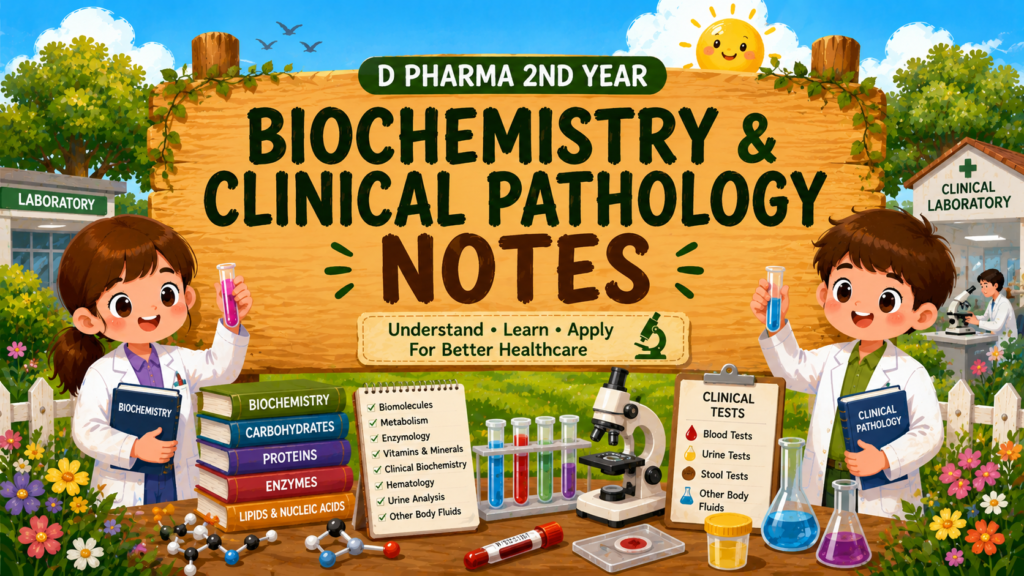
The human body constantly performs thousands of chemical reactions to maintain life—from producing energy and digesting food to regulating hormones and defending against disease. Understanding these biochemical processes and the laboratory methods used to detect abnormalities is the focus of Biochemistry & Clinical Pathology, an important subject in D Pharma 2nd Year.
This subject helps students understand the chemical composition of the body, the metabolism of nutrients, and the biological changes that occur during different diseases. It also introduces clinical laboratory investigations used in diagnosing disorders related to blood, urine, and other body fluids. Through this subject, students begin to connect laboratory findings with disease conditions and therapeutic care.
These Biochemistry & Clinical Pathology Notes – Download PDF Now (D Pharma 2nd Year) are prepared according to the current diploma syllabus and organized in a clear chapter-wise format for easier learning and revision. Whether you are preparing for theory exams, practicals, viva, or assignments, the notes are designed to simplify complex biochemical and pathological concepts in a practical and student-friendly manner.
Download Biochemistry & Clinical Pathology Notes PDF – Chapter Wise
Click below to download free PDFs for each unit:
Chapter 1: Introduction to Biochemistry
Topics Covered: Introduction and scope of biochemistry in pharmacy; biochemical organization of the cell; importance of biochemistry in understanding body functions, diseases, and drug action.
Chapter 2: Carbohydrates
Topics Covered: Definition and classification of carbohydrates with examples; chemical properties of carbohydrates; structure of monosaccharides such as glucose, fructose, and galactose; structure of disaccharides including maltose, lactose, and sucrose; chemical nature of polysaccharides such as starch and glycogen; qualitative tests and biological role of carbohydrates in the body.
Chapter 3: Proteins
Topics Covered: Definition and classification of proteins based on composition and solubility; classification of amino acids based on chemical nature and nutritional requirements; structure of proteins including four levels of protein organization; qualitative tests and biological role of proteins and amino acids; and diseases related to protein malnutrition.
Chapter 4: Lipids
Topics Covered: Definition and classification of lipids with examples; structure and properties of triglycerides including oils and fats; classification of fatty acids based on chemical and nutritional requirements; structure and functions of cholesterol; lipoproteins including types, composition, and functions; qualitative tests and biological functions of lipids.
Chapter 5: Nucleic Acids
Topics Covered: Definition of nucleic acids; purine and pyrimidine bases; components of nucleosides and nucleotides with examples; structure of DNA based on Watson and Crick model; structure and functions of RNA.
Chapter 6: Enzymes
Topics Covered: Definition, properties, and IUB and MB classification of enzymes; factors affecting enzyme activity; mechanism of enzyme action and enzyme inhibitors; therapeutic and pharmaceutical importance of enzymes.
Chapter 7: Vitamins
Topics Covered: Definition and classification of vitamins; sources, chemical nature, functions, coenzyme forms, recommended dietary requirements, and deficiency diseases of fat-soluble and water-soluble vitamins.
Chapter 8: Metabolism
Topics Covered: Metabolism of carbohydrates including glycolysis, TCA cycle, glycogen metabolism, and regulation of blood glucose levels; disorders related to carbohydrate metabolism; metabolism of lipids including lipolysis, beta-oxidation, ketogenesis, and ketolysis along with lipid metabolism disorders; metabolism of amino acids including transamination, deamination, urea cycle, and decarboxylation along with related metabolic disorders; biological oxidation including electron transport chain and oxidative phosphorylation.
Chapter 9: Minerals
Topics Covered: Types and functions of minerals; deficiency diseases caused by mineral deficiencies; and recommended dietary requirements of essential minerals.
Chapter 10: Water and Electrolytes
Topics Covered: Distribution and functions of water in the body; water turnover and balance; electrolyte composition of body fluids; dietary intake and balance of electrolytes; dehydration, causes of dehydration, and oral rehydration therapy.
Chapter 11: Introduction to Biotechnology
Topics Covered: Introduction to biotechnology and its applications in pharmacy, medicine, healthcare, and pharmaceutical industries.
Chapter 12: Organ Function Tests
Topics Covered: Functions of kidney and liver; routinely performed tests to assess kidney and liver functions and their clinical significance; lipid profile tests and their importance in diagnosis of diseases.
Why Study Biochemistry & Clinical Pathology in D Pharma?
Studying Biochemistry & Clinical Pathology is a critical component of the Diploma in Pharmacy (D.Pharm) curriculum. It serves as the essential bridge between understanding how the human body functions normally at a chemical level and how diseases disrupt those precise functions.
Here is a comprehensive breakdown of why this subject is indispensable for a career in pharmacy:
1. Understanding the Building Blocks of Life (Biochemistry)
Before you can understand how a drug affects the body, you must understand what the body is made of. Biochemistry focuses on the molecular organization of tissues, cells, and organelles.
Biomolecules: You learn the structure, chemical properties, and biological roles of essential macromolecules: carbohydrates, proteins, lipids, and nucleic acids.
Catalysts of Life: The subject covers how enzymes drive chemical reactions and how vitamins and minerals act as crucial co-enzymes to keep biological systems running smoothly.
2. Decoding Disease Through Metabolism
Biochemistry doesn’t just look at static molecules; it examines them in motion through metabolic pathways.
Normal vs. Abnormal Pathways: By studying processes like glycolysis, the TCA cycle, and beta-oxidation, you learn how the body generates energy and builds tissue.
Root Causes of Illness: When these metabolic pathways fail, metabolic disorders occur. This subject explains the exact biochemical breakdowns behind widespread conditions like diabetes mellitus (carbohydrate metabolism), ketoacidosis (lipid metabolism), and jaundice (amino acid metabolism).
3. Interpreting Diagnostics (Clinical Pathology)
Modern pharmacists must be able to read and comprehend medical test reports to counsel patients effectively and ensure the safety of prescribed therapies. The clinical pathology section of the syllabus trains you to evaluate organ health and bodily fluids:
Organ Function Tests: You learn the clinical significance of Liver Function Tests (LFT) and Kidney Function Tests (KFT), which are vital since the liver metabolizes most drugs and the kidneys excrete them.
Blood and Urine Pathology: It covers how to detect and interpret abnormalities in the blood (such as hypercholesterolemia or altered lipid profiles) and urine (such as proteinuria or the presence of glucose), which are primary indicators of underlying diseases.
4. Establishing a Foundation for Pharmacology
You cannot fully grasp pharmacology (the study of drugs) without a strong grasp of biochemistry.
Drug Targets: The vast majority of medications work by targeting specific biochemical pathways—often by inhibiting an enzyme or altering a receptor’s activity. Understanding the underlying chemistry makes it infinitely easier to understand pharmacodynamics (what the drug does to the body).
5. Enhancing Professional Patient Care
Ultimately, this subject elevates a pharmacist from a basic medicine dispenser to a highly knowledgeable healthcare professional. It equips you to:
Correlate a patient’s prescribed medication with their diagnostic lab reports.
Anticipate and identify potential drug-disease interactions based on a patient’s metabolic state.
Provide scientifically sound advice regarding nutritional supplements, vitamins, and dietary adjustments.
Frequently Asked Questions (FAQ)
Q1. How do the notes explain the clinical relationship between Enzymes and Vitamins?
The material connects these two distinct chapters (Chapter 6 and 7) through the mechanics of cellular reactions. Enzymes act as the biological machinery that accelerates chemical processes, but many cannot function alone. Vitamins serve as the essential raw materials needed to create coenzymes, which unlock or activate those enzymes. This is why a single vitamin deficiency can stall an entire metabolic pathway, leading to specific deficiency diseases.
Q2. What is the purpose of studying "Water and Electrolyte Balance" in Clinical Pathology?
Chapter 10 goes beyond basic hydration to look at the exact electrolyte composition of bodily fluids. Pharmacists frequently manage cases of severe dehydration, vomiting, or diarrhea where the body’s chemical equilibrium is disrupted. Understanding how ions like sodium, potassium, and chloride maintain osmotic pressure provides the scientific rationale behind Oral Rehydration Therapy (ORT) and intravenous fluid management.
Q3. How does the inclusion of Biotechnology alter modern pharmaceutical manufacturing?
Introduced in Chapter 11, biotechnology moves pharmacy past traditional chemical synthesis. It teaches students how living organisms, cells, or molecular variations are engineered to manufacture complex biologics, such as recombinant human insulin, targeted monoclonal antibodies, and advanced vaccines that would be impossible to create through standard inorganic or organic chemistry.
Q4. How does Biochemistry in the 2nd year bridge the gap between laboratory science and actual patient care?
In your first year, you studied how the human body is structured; Biochemistry & Clinical Pathology teaches you how it runs on a molecular level. By understanding cellular chemical reactions, you transition from simply memorizing drug names to understanding why a drug is given. For example, knowing how a molecule targets a specific enzyme or alters a metabolic pathway allows you to predict drug actions, manage side effects, and scientifically read patient diagnostic reports.