

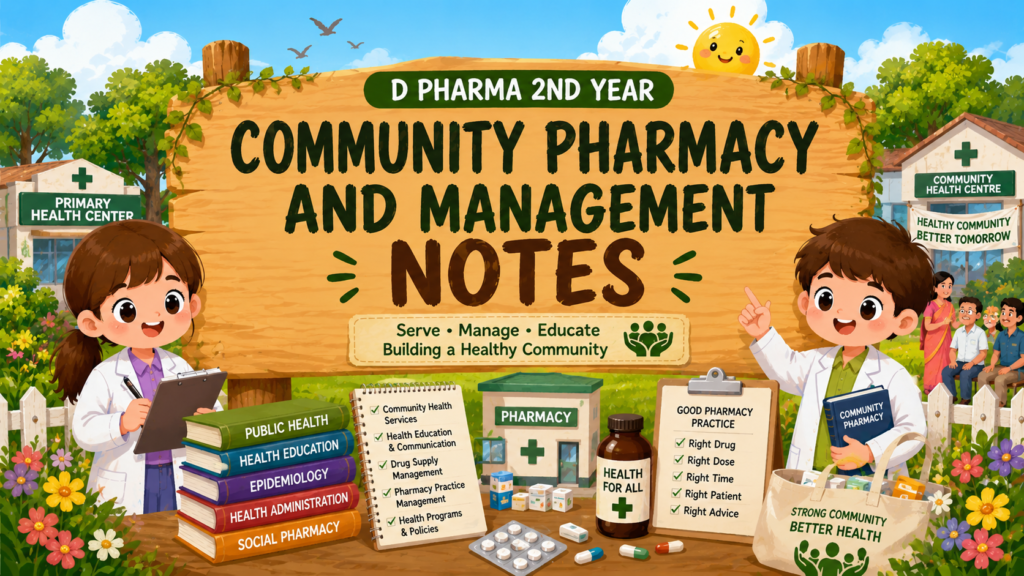
Modern pharmacy is not only about supplying medicines—it is also about guiding patients, managing healthcare services, and ensuring the safe use of drugs in everyday life. These practical responsibilities are covered in Community Pharmacy and Management, an important subject in D Pharma 2nd Year that introduces students to the real working environment of retail and community pharmacies.
This subject helps students understand how pharmacists interact directly with patients, handle prescriptions, manage medicine inventories, and support healthcare awareness in society. It also highlights the importance of communication skills, professional ethics, patient counseling, and pharmacy management in daily pharmaceutical practice.
These Community Pharmacy and Management Notes – Download PDF Now (D Pharma 2nd Year) are prepared according to the current diploma syllabus and arranged in a clear chapter-wise format for easier learning and revision. Whether you are preparing for theory exams, practical work, viva, or professional training, the notes are designed to make pharmacy management and community healthcare concepts simple, practical, and easy to understand.
Download Community Pharmacy and Management Notes PDF – Chapter Wise
Click below to download free PDFs for each unit:
Chapter 1: Community Pharmacy Practice
Topics Covered: Definition, history, and development of community pharmacy; evolution of community pharmacy practice in international and Indian scenarios; role and importance of community pharmacists in healthcare services.
Chapter 2: Professional Responsibilities of Community Pharmacists
Topics Covered: Professional responsibilities and ethical duties of community pharmacists; introduction to Good Pharmacy Practice (GPP); importance and implementation of Standard Operating Procedures (SOPs) in community pharmacy settings.
Chapter 3: Prescription and Prescription Handling
Topics Covered: Definition and parts of a prescription; legality and handling of prescriptions; labelling of dispensed medicines including main labels, ancillary labels, and pictograms; brief medication usage instructions; dispensing process, good dispensing practices, dispensing errors, and strategies to minimize dispensing errors.
Chapter 4: Communication Skills
Topics Covered: Definition and types of communication skills; interaction with healthcare professionals and patients; verbal and written communication skills; telephone communication; body language; and patient interview techniques in pharmacy practice.
Chapter 5: Patient Counselling
Topics Covered: Definition, importance, and benefits of patient counselling; stages of patient counselling including introduction, counselling content, counselling process, and closing of counselling sessions; barriers to effective counselling and methods to overcome them; counselling points for chronic diseases such as hypertension, diabetes, asthma, tuberculosis, COPD, and AIDS; patient package inserts (PPI) and patient information leaflets including their importance and uses.
Chapter 6: Medication Adherence
Topics Covered: Definition of medication adherence; factors responsible for non-adherence to medications; and strategies to improve medication adherence and patient compliance.
Chapter 7: Health Screening Services in Community Pharmacy
Topics Covered: Introduction, scope, and importance of health screening services in community pharmacies; routine monitoring of patients; early detection of diseases; and referral services for undiagnosed conditions.
Chapter 8: Over The Counter (OTC) Medications
Topics Covered: Definition and importance of OTC medications; role of pharmacists in OTC dispensing and patient counselling; self-medication and promotion of safe self-care practices; responding to symptoms and management of minor ailments such as pain, cough, cold, diarrhea, constipation, vomiting, fever, sore throat, skin disorders, and oral health problems.
Chapter 9: Community Pharmacy Management
Topics Covered: Legal requirements for setting up a community pharmacy; site selection, pharmacy design, and interiors; vendor selection and procurement; inventory control and management; financial planning and accountancy including day book and cash book; introduction to pharmacy operation software; customer relationship management (CRM); pharmacy audits; SOPs in pharmacy management; and introduction to digital health, mHealth, and online pharmacies.
What is Community Pharmacy and Management?
Community Pharmacy and Management is the area of pharmacy that focuses on patient-centered healthcare services provided through retail and community pharmacies. It explains how pharmacists interact with patients, manage medicines, provide healthcare guidance, and ensure the safe and effective use of drugs in everyday practice.
For D Pharma 2nd Year students, this subject is highly important because it introduces the practical responsibilities of pharmacists in real healthcare settings. It combines pharmaceutical knowledge with communication skills, pharmacy operations, inventory control, and patient counseling.
These notes will help you understand topics like:
- Introduction to Community Pharmacy Practice: Role, historical evolution, and professional responsibilities of pharmacists in community healthcare settings.
- Prescription Handling & Communication Skills: Interpretation of prescriptions, legal requirements, labeling protocols, good dispensing practices, and effective patient interview techniques.
- Patient Counseling & Medication Adherence: Structured stages of patient counseling, managing chronic disease profiles, and implementing strategies to overcome non-adherence.
- Health Screening Services: Methods for routine patient monitoring, early detection of disease states, and professional referral pathways.
- Over The Counter (OTC) Medications: Pharmacist roles in OTC dispensing, promoting safe self-care, and managing minor ailments like pain, cough, cold, and fever.
- Community Pharmacy Management & Inventory Control: Legal setup requirements, site design, procurement, financial record-keeping (day books/cash books), audits, and pharmacy software applications.
- Digital Health & Professional Ethics: Introduction to online pharmacies, mHealth networks, and legal/ethical considerations in daily operations
These Community Pharmacy and Management Notes PDF for D Pharma 2nd Year are designed to simplify practical pharmacy concepts, improve exam preparation, and help students develop the professional skills required for modern pharmacy practice.
Frequently Asked Questions (FAQ)
Q1. What is the main focus of Community Pharmacy and Management?
Community Pharmacy focuses on the professional services provided in a retail setting. It shifts the emphasis from simply selling medicines to patient-centered care, including effective communication, health screening, and business management.
Q2. Why is "Patient Counselling" considered a core chapter?
Chapter 5 explains that counseling is vital for ensuring patients understand how to take their medicine correctly. It covers specific advice for chronic conditions like Hypertension, Diabetes, and Asthma, and teaches how to use Patient Information Leaflets (PIL) to overcome communication barriers.
Q3. What are "Health Screening Services" in a pharmacy?
In Chapter 7, students learn about the pharmacist’s role in early disease detection. This includes routine monitoring (like blood pressure or glucose checks) and referring patients to doctors when undiagnosed conditions are suspected.
Q4. What role do pharmacists play in OTC medications?
Pharmacists are the primary gatekeepers for Over-The-Counter (OTC) drugs. Chapter 8 details how to manage minor ailments (fever, cold, pain) safely while discouraging harmful self-medication practices.