

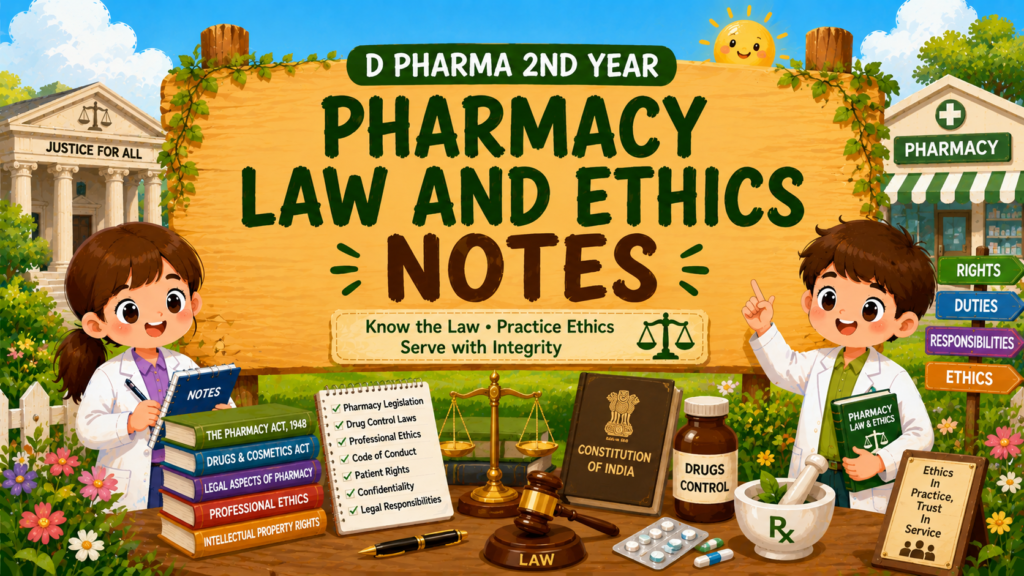
The pharmacy profession is not guided by science alone—it also operates under strict legal and ethical responsibilities that protect patient safety and public health. These important professional standards are studied in Pharmacy Law and Ethics, a key subject in D Pharma 2nd Year that helps students understand the legal framework governing medicines, pharmacies, and pharmaceutical practice.
This subject introduces students to the laws related to the manufacture, storage, distribution, dispensing, and sale of drugs. It also explains the ethical responsibilities of pharmacists while dealing with patients, prescriptions, controlled substances, and healthcare services. Through this subject, students learn how professional conduct, legal compliance, and patient rights play a major role in safe pharmacy practice.
These Pharmacy Law and Ethics Notes – Download PDF Now (D Pharma 2nd Year) are prepared according to the current diploma syllabus and organized in a simple chapter-wise format for easier learning and revision. Whether you are preparing for theory exams, viva, assignments, or pharmacist registration preparation, the notes are designed to make legal and ethical pharmacy concepts easier to understand and remember.
Download Pharmacy Law and Ethics Notes PDF – Chapter Wise
Click below to download free PDFs for each unit:
Chapter 1: General Principles of Law and Pharmaceutical Legislation
Topics Covered: General principles of law; history and development of pharmaceutical legislation; introduction to various Acts related to drugs and pharmacy profession in India.
Chapter 2: Pharmacy Act 1948 and Pharmacy Practice Regulations
Topics Covered: Objectives and definitions of the Pharmacy Act 1948; constitution and functions of the Pharmacy Council of India; Education Regulations; State and Joint State Pharmacy Councils; registration of pharmacists; offences and penalties; and Pharmacy Practice Regulations 2015.
Chapter 3: Drugs and Cosmetics Act 1940 and Rules 1945
Topics Covered: Objectives, definitions, and important schedules under the Drugs and Cosmetics Act and Rules; import, manufacture, and sale of drugs; conditions for licenses; manufacture of drugs for examination and analysis; loan and repacking licenses; study of Schedules C, C1, G, H, H1, K, P, M, N, and X; prohibited drugs; administration of the Act; and functions of DTAB, CDL, DCC, Drug Inspectors, and licensing authorities.
Chapter 4: Narcotic Drugs and Psychotropic Substances Act 1985
Topics Covered: Objectives, definitions, authorities, prohibition, control, regulation, offences, and penalties under the Narcotic Drugs and Psychotropic Substances Act and Rules.
Chapter 5: Drugs and Magic Remedies Act 1954
Topics Covered: Objectives, definitions, prohibition of objectionable advertisements, exempted advertisements, offences, and penalties under the Drugs and Magic Remedies (Objectionable Advertisements) Act.
Chapter 6: Prevention of Cruelty to Animals Act 1960
Topics Covered: Objectives and definitions of the Prevention of Cruelty to Animals Act; overview of CPCSEA; Institutional Animal Ethics Committee; breeding, stocking, transfer, acquisition, and experimentation on animals; records, suspension of registration, offences, and penalties.
Chapter 7: Poisons Act 1919
Topics Covered: Introduction, objectives, definitions, possession, sale, and import of poisons under the Poisons Act 1919.
Chapter 8: FSSAI Act and Rules
Topics Covered: Overview of Food Safety and Standards Authority of India (FSSAI) Act and Rules; regulations related to manufacture, storage, sale, and labelling of food supplements.
Chapter 9: National Pharmaceutical Pricing Authority and DPCO
Topics Covered: Objectives and provisions of National Pharmaceutical Pricing Authority (NPPA); Drugs Price Control Order (DPCO) 2013; pricing of bulk drugs and formulations; ceiling prices; Pharmaceutical Policy 2002; and National List of Essential Medicines (NLEM).
Chapter 10: Code of Pharmaceutical Ethics
Topics Covered: Definition and principles of pharmaceutical ethics; ethical problem solving; registration; code of ethics for pharmacists in relation to profession, trade, and medical profession; and pharmacist’s oath.
Chapter 11: Medical Termination of Pregnancy Act
Topics Covered: Basic understanding, important provisions, salient features, and amendments of the Medical Termination of Pregnancy Act and Rules.
Chapter 12: Government Pharmaceutical Regulatory Bodies
Topics Covered: Role and functions of government pharmaceutical regulatory bodies including Central Drugs Standard Control Organization (CDSCO) and Indian Pharmacopoeia Commission (IPC).
Chapter 13: Good Regulatory Practices
Topics Covered: Good regulatory practices including documentation, licensing, renewals, e-governance, inspections, import and export of drugs and medical devices in community pharmacy, hospital pharmacy, pharmaceutical manufacturing, and wholesale business.
Chapter 14: Drug Development and Intellectual Property Rights
Topics Covered: Introduction to BCS classification system; basic concepts of clinical trials, ANDA, NDA, and new drug development; New Drugs and Clinical Trials Rules 2019; brand and generic medicines; trade names; introduction to patent law and intellectual property rights; and Emergency Use Authorization.
Chapter 15: Blood Bank
Topics Covered: Basic requirements, functions, storage, handling, and services provided by blood banks in healthcare systems.
Chapter 16: Clinical Establishment Act and Rules
Topics Covered: Introduction and important provisions of Clinical Establishment Act and Rules related to pharmacy services and healthcare establishments.
Chapter 17: Biomedical Waste Management Rules 2016
Topics Covered: Biomedical waste management rules and regulations; handling, segregation, storage, transport, and disposal of pharmaceutical and medical waste in homes, pharmacies, hospitals, and pharmaceutical industries.
Chapter 18: Bioethics
Topics Covered: Basic concepts, history, and principles of bioethics; overview of ICMR National Ethical Guidelines for Biomedical and Health Research involving human participants.
Chapter 19: Consumer Protection Act
Topics Covered: Introduction to the Consumer Protection Act and its relevance in pharmacy practice and healthcare services.
Chapter 20: Disaster Management Act
Topics Covered: Introduction, objectives, and importance of the Disaster Management Act in healthcare and pharmaceutical services.
Chapter 21: Medical Devices
Topics Covered: Categorization of medical devices; basic concepts related to manufacture, regulation, storage, and sale of medical devices.
Why Study Pharmacy Law and Ethics in D Pharma?
Studying Pharmacy Law and Ethics (often traditionally referred to as Pharmaceutical Jurisprudence) is essential in the Diploma in Pharmacy (D.Pharm) curriculum because dealing with medications is inherently dealing with human life. While other subjects teach you the science of drugs, this subject teaches you the legal boundaries and moral responsibilities of handling them.
Here is a breakdown of why this subject is a critical pillar of pharmacy education:
1. The Legal Foundation of Practice
To practice as a pharmacist, you must understand the strict laws that govern the profession to avoid severe legal penalties, license cancellation, or imprisonment.
The Pharmacy Act: You learn how the pharmacy profession is regulated, how the Pharmacy Council operates, and the strict requirements for registering as a legally recognized pharmacist.
The Drugs and Cosmetics Act: This is the master rulebook. It dictates the exact legal requirements for importing, manufacturing, distributing, and selling drugs to ensure substandard or counterfeit medicines do not reach the public.
2. Preventing Drug Abuse and Illegal Trade
Pharmacists handle powerful substances that, if misused, can destroy lives and communities.
Handling Narcotics: Through the Narcotic Drugs and Psychotropic Substances (NDPS) Act, you learn the intense regulations, security measures, and meticulous record-keeping required to dispense highly addictive medications (like morphine or certain sedatives) safely and legally.
Poisons and Dangerous Drugs: You learn how to safely store and log the sale of toxic substances to prevent deliberate or accidental harm.
3. The Moral Compass (Professional Ethics)
Laws tell you what you must do; ethics tell you what you should do.
The Code of Pharmaceutical Ethics: This subject establishes the standard of professional conduct. It teaches you how to interact ethically with patients, doctors, and fellow pharmacists.
Patient Confidentiality: You learn the critical importance of keeping a patient’s medical history and prescriptions strictly private.
Fair Practices: It covers the ethical obligation to provide the correct medication without unnecessary substitution for higher profit, ensuring the patient’s health is always prioritized over financial gain.
4. Protecting the Public from Exploitation
Pharmacists act as a shield against corporate exploitation and medical fraud.
Price Control: Through the Drugs (Prices Control) Order (DPCO), you learn how the government caps the prices of essential medicines so they remain affordable for the general public, and your legal obligation to adhere to these prices.
Combating False Claims: The Drugs and Magic Remedies Act teaches you to identify and reject misleading advertisements that falsely claim to cure incurable diseases (like cancer or diabetes), protecting desperate patients from fraud.
5. Establishing and Running a Pharmacy Business
For those intending to open a community pharmacy, this subject is an operational necessity.
Licensing and Inspection: You learn the exact legal prerequisites for opening a retail or wholesale pharmacy, including minimum space requirements, required facilities, and how to prepare for visits from Drug Inspectors.
Documentation: You learn how to properly maintain prescription registers, expiry logs, and purchase records, which are legally mandated for the business to operate smoothly.
Ultimately, Pharmacy Law and Ethics transforms a student from someone who simply knows about medicines into a legally accountable and morally responsible healthcare professional whom the public can trust.
Frequently Asked Questions (FAQ)
Q1. What is the practical difference between a pharmacy "Law" and a pharmacy "Ethic"?
While they both guide the profession, they operate on different mechanisms. A Law is a legally binding rule enacted by the government (such as the Drugs and Cosmetics Act). Breaking it results in concrete penalties like fines, license revocation, or imprisonment. An Ethic, governed by the Code of Pharmaceutical Ethics, is a moral obligation. Breaking it might not land you in court, but it can lead to professional ostracization and your name being struck off the pharmacist register for professional misconduct.
Q2. How does the Drugs and Cosmetics Act protect consumers from deceptive manufacturing?
The Act establishes absolute standardization through specific legal frameworks detailed in Chapter 3. It defines legal boundaries for Misbranded, Adulterated, and Spurious drugs. By enforcing strict manufacturing conditions under Schedule M (Good Manufacturing Practices), the law ensures that medications are pure, accurately labeled, and produced in environments that prevent cross-contamination.
Q3. What parameters prevent fraudulent healthcare advertisements in India?
The Drugs and Magic Remedies (Objectionable Advertisements) Act 1954, covered in Chapter 5, acts as a consumer shield. It completely prohibits any public advertisement claiming a drug or “magic charm” can prevent or cure specific chronic conditions listed in the Act’s schedule (such as cancer, diabetes, blindness, or epilepsy). This prevents predatory companies from exploiting vulnerable patients with false hope.
Q4. What legal protections does the Consumer Protection Act offer a patient against medical negligence?
As highlighted in Chapter 19, a patient is legally recognized as a “consumer” of healthcare services. If a pharmacist dispenses the wrong medication, gives an incorrect dosage instruction, or sells a defective medical device that results in physical harm, the patient has the right to bypass slow civil courts and file a direct claim in specialized Consumer Forums for rapid financial compensation and legal redressal.